Hardwood flooring offers timeless beauty, durability, and the ability to enhance any space, but choosing between engineered and solid hardwood can be confusing. Each type has unique qualities that cater to different needs, environments, and budgets. Homeowners and business owners often find themselves weighing the pros and cons to determine which is better for their specific situation. According to the National Wood Flooring Association, hardwood floors can last well over 100 years with proper care, making them one of the most enduring investments in home improvement. Understanding the key differences between engineered and solid hardwood flooring can help make an informed decision.
Solid Hardwood Flooring Explained
Solid hardwood flooring is crafted from a single piece of wood, offering natural character and a refined finish. Its durability is well known because the material can usually be sanded and refinished several times during its service life. The National Wood Flooring Association reports that the lifespan of a wood floor can exceed 100 years when the flooring is properly installed and maintained. A flooring contractor can evaluate the subfloor, indoor humidity, wood species, and installation area before recommending solid hardwood. This flooring performs especially well in traditional interiors, although owners must consider moisture control and routine maintenance.
- Can be sanded and refinished multiple times for greater longevity.
- Performs best in areas with relatively stable humidity levels.
- Often carries a higher initial cost but can provide an exceptional lifespan.
Understanding Engineered Hardwood Flooring
Engineered hardwood is constructed from multiple layers, including a visible top layer of high-quality wood. This layered design helps the boards expand and contract less than solid hardwood during changes in humidity and temperature, which is why the National Wood Flooring Association considers engineered wood suitable for basement installations. Moisture still matters because the USDA Forest Products Laboratory explains that wood absorbs moisture from its surrounding environment according to the temperature, relative humidity, and existing moisture content of the material. Engineered hardwood can therefore work well in below-grade rooms and other spaces where solid hardwood may be more vulnerable to dimensional movement.
- Suitable for many below-grade installations, including basements.
- Often costs less than comparable solid hardwood products.
- Available in a broad selection of wood species, finishes, colors, and plank styles.
Installation and Maintenance Differences
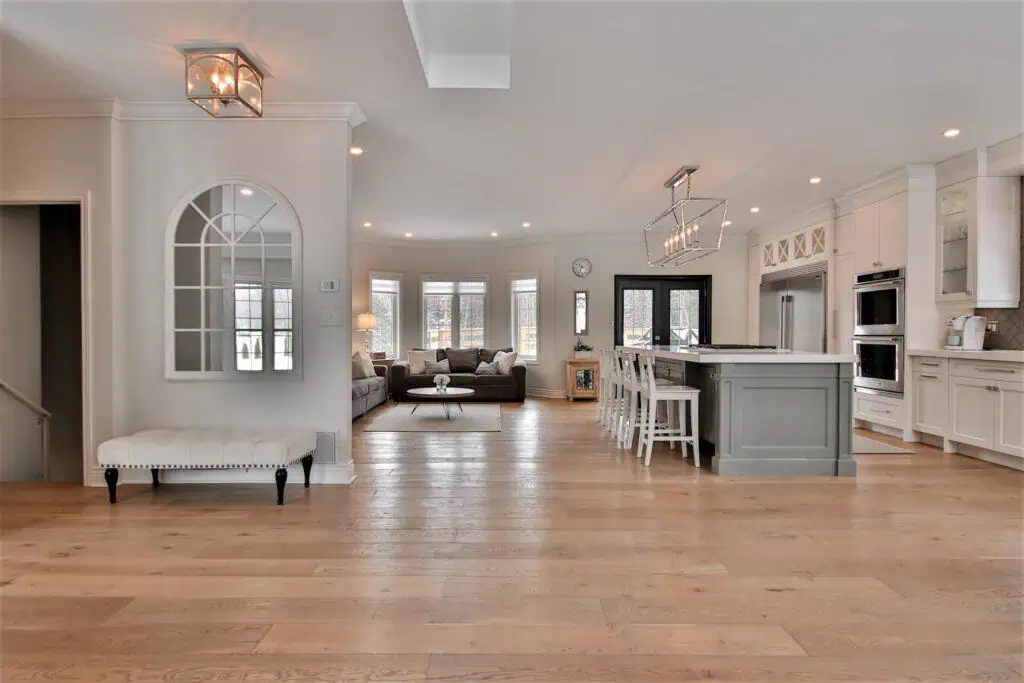
The installation process varies considerably between solid and engineered hardwood flooring. Solid hardwood commonly requires professional installation because the boards must be acclimated and are typically fastened to a suitable wood subfloor, while engineered hardwood may support nail-down, glue-down, or floating installation methods depending on the product. The USDA Forest Products Laboratory explains that major dimensional problems can usually be avoided when wood is installed at a moisture level suited to the surrounding atmospheric conditions. A flooring contractor can measure moisture levels, inspect the subfloor, and determine which installation method is appropriate for the space. Maintenance also differs because solid hardwood may be refinished several times, while engineered products rely heavily on protecting their thinner surface veneer and factory-applied finish.
- Solid hardwood requires proper acclimation and moisture testing before installation.
- Engineered hardwood may allow faster installation through several approved methods.
- Maintenance for both materials depends on prompt spill cleanup and manufacturer-approved cleaning routines.
Cost and Value Considerations
Hardwood flooring costs can influence the final decision, particularly when large rooms or entire properties are being renovated. Solid hardwood often carries a higher initial price because of its natural construction, installation requirements, and ability to undergo repeated refinishing. Engineered hardwood is frequently more affordable, although its potential lifespan and refinishing options depend heavily on the thickness of the real-wood veneer. The National Association of Realtors reported that new wood flooring could recover an estimated 118% of its cost at resale, while refinishing existing hardwood was estimated to recover 147%. Actual returns can vary according to the property, local market, material quality, and installation workmanship.
- Solid hardwood has higher upfront costs but can generally be refinished more often.
- Engineered hardwood is usually more budget-friendly and may reduce installation labor.
- New wood flooring has been estimated to recover 118% of its project cost at resale.
Key Takeaways for Flooring
Selecting between engineered and solid hardwood flooring depends on factors like budget, location, and intended use. Solid hardwood offers unparalleled authenticity and longevity but requires stable conditions and professional installation. Engineered hardwood provides versatility and moisture resistance, making it ideal for areas with fluctuating humidity.
- Solid hardwood is best for areas with stable environments.
- Engineered hardwood excels in moisture-prone or high-traffic spaces.
- Consider long-term maintenance and installation costs when deciding.
Frequently Asked Questions About Flooring
1. Can solid hardwood be installed in basements?
Solid hardwood is not ideal for basements due to its susceptibility to moisture and humidity. Engineered hardwood is a better option for below-grade installations.
2. How often can solid hardwood be refinished?
Most solid hardwood floors can be refinished 5–7 times over their lifespan, depending on the thickness of the planks.
3. Is engineered hardwood eco-friendly?
Engineered hardwood can be eco-friendly when made from sustainable materials, and it uses less solid wood compared to traditional hardwood planks.
4. Does engineered hardwood scratch easily?
Engineered hardwood is often finished with a durable topcoat, making it more resistant to scratches and wear than untreated solid hardwood.
5. Which type of hardwood is better for high-traffic areas?
Engineered hardwood is better suited for high-traffic areas due to its durability and resistance to wear, especially when treated with a strong finish.